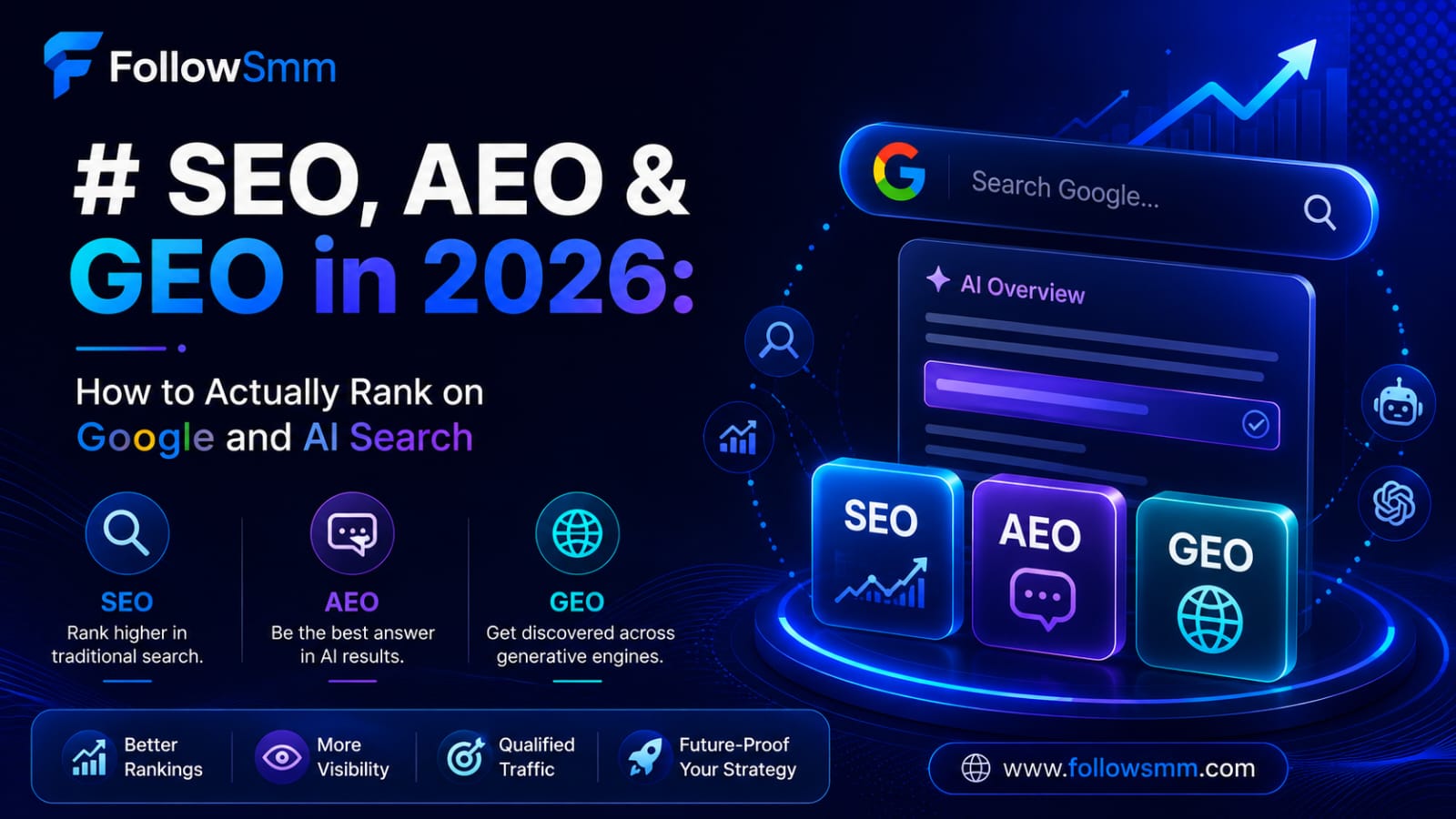

Search stopped being "ten blue links" a while ago. People now ask ChatGPT, Google AI Overviews, Gemini, and Perplexity direct questions and get synthesized answers without ever clicking a link. That doesn't mean SEO is dead — AI systems still rely on the same crawling and trust signals search engines have always used. It means the game now has more layers, and most sites are only playing one of them.
Here's the full framework, broken down so you can actually act on it — including a real before/after audit so you can see what each fix looks like in practice.
SEO vs. AEO vs. GEO vs. Entity SEO
These terms get thrown around interchangeably, but each one solves a different problem.
| Layer | Goal | Main Tools |
|---|---|---|
| SEO | Rank your page in traditional search results | Title tags, meta descriptions, keywords, backlinks, page speed |
| AEO | Get selected as the direct answer to a question | FAQ schema, answer-first paragraphs, clear headings |
| GEO | Get cited or mentioned inside AI-generated responses | Original data, third-party mentions, fresh content, authority signals |
| Entity SEO | Make your brand a recognized "entity," not just a webpage | Organization schema, consistent naming, sameAs links, Knowledge Panel |
Industry analysts increasingly describe these as a layered stack rather than separate strategies: SEO builds the infrastructure AI crawlers need to find you, AEO wins the immediate answer, and GEO is what turns that visibility into an actual citation inside the AI's response. Pull out any one layer and the whole stack gets shakier.
Step 1: Fix the SEO Foundation First
None of the AI-search layers matter if a page isn't being crawled, indexed, and understood correctly in the first place. Before anything else, check the fundamentals on every important page:
- A real, descriptive title tag (50–60 characters, keyword + brand) — not a placeholder like "Sign in" or "Home."
- A written meta description that actually explains the page, instead of leaving it blank for Google to auto-generate from random text.
- Fast load times. AI crawlers have limited patience — pages that respond slowly can get dropped mid-crawl before they're even read.
- Mobile-first, crawlable pages with important content rendered as real text, not locked inside images or scripts.
A Real Before/After Example
To make this concrete, here's an actual homepage audit we ran this week — the exact kind of issue that's more common than you'd think, even on established sites.
That one fix — three small changes to a single page — moved the site from being functionally invisible to both Google and AI crawlers, to being fully eligible for rich results and AI citation. Most sites have at least one page in this exact state and don't know it.
Step 2: Structure Content for AEO
Answer engines reward directness over cleverness. The goal is content that can be lifted and used as a standalone answer, not content that requires reading the whole page to understand.
- Answer first, explain second. Open each section with a complete answer in one or two sentences, then expand with context below it.
- Use FAQ, list, and table formats. These are the formats answer engines extract most reliably, because the structure itself signals what's a question and what's the answer.
- Write in plain, precise language. Ambiguity and jargon reduce how easily AI systems can interpret and reuse your content.
- Add schema markup (FAQPage, HowTo, Article) so the structure is machine-readable, not just visually clear to a human reader.
Step 3: Build Entity SEO
Entity SEO is about making sure your brand is understood as a distinct, connected "thing" — not just a page full of keywords. AI systems map relationships between entities rather than reading text the way a person does, so this step is what lets them place your brand correctly in that map.
- Organization schema on your homepage, defining your name, URL, and description in a consistent, structured way.
- sameAs links connecting your schema to your verified social profiles and other trusted platforms, so systems can confirm it's really you.
- Consistent naming across your website, social bios, directories, and any press mentions — inconsistent naming confuses entity matching.
- knowsAbout / service schema that clearly lists the topics and services your brand is actually associated with.
Step 4: Earn GEO Visibility
GEO is the layer most sites skip entirely, because it's less about your own website and more about your presence across the wider web. AI models draw heavily on third-party sources — forums, review platforms, and video content — when deciding what to cite.
- Show up where AI already looks. Reddit, YouTube, and category-specific forums are consistently among the most-cited source types by major AI models.
- Publish original data or perspective. Content that only repeats what's already online is treated as low-value; a genuine before/after audit, a real number, or a first-hand example earns more trust.
- Keep content fresh. Pages updated within the last several months consistently perform better in AI-generated answers than stale ones.
- Build real E-E-A-T signals. Clear authorship, accurate claims, and consistency across your site are what let AI systems treat you as a trustworthy source worth citing.
Common Mistakes That Undo This Work
- Leaving placeholder titles live. "Sign in," "Home," or a default CMS title on an important page is more common — and more damaging — than most site owners realize.
- Writing FAQs without schema. Great answer content that isn't marked up is invisible to the systems that would otherwise surface it.
- Inconsistent brand naming. Small variations across your site, socials, and directories weaken entity recognition.
- Publishing once and never updating. Freshness is a real ranking and citation factor now, not a nice-to-have.
- Chasing keywords instead of answering questions. Content built around a keyword often reads as thin; content built around a real question tends to satisfy both a human reader and an AI system.
The FollowSMM Advantage
SEO, AEO, and GEO get your brand found and cited — but visibility only converts when the audience landing on your page sees real signs of an active, trusted brand. That's where the growth side of the equation comes in, and it's the niche FollowSMM was built around.
- Real, gradual growth across every major platform. Instagram, TikTok, YouTube, and more — delivered the way organic growth actually looks, which supports rather than undermines the trust signals AI and search engines are already evaluating.
- Instant order processing. Most services start within minutes, so momentum builds while your content and SEO work are still fresh.
- No password requests, ever. Growth support that never puts your account access at risk.
- Refill guarantee. Natural attrition happens even with quality growth — FollowSMM replaces drop-off instead of leaving you to top it up yourself.
- API access for resellers and agencies. Built for anyone managing growth across multiple brands or client accounts, not just single-account creators.
- 24/7 support and multiple secure payment options, including crypto, so help and access are never a bottleneck.
Think of it as the other half of the strategy this guide covers: SEO and AEO/GEO make sure people and AI systems can find and trust your brand, while genuine, well-paced social growth makes sure what they find actually looks like a brand worth trusting.
Frequently Asked Questions
What is the difference between SEO, AEO, and GEO?
SEO ranks your pages in traditional search results. AEO structures content so AI systems can extract it as a direct answer. GEO focuses on getting your brand cited or mentioned inside AI-generated responses from tools like ChatGPT, Gemini, and Perplexity. They work as layers, not competing strategies.
Do I need Entity SEO if I already do regular SEO?
Yes. Entity SEO makes sure search engines and AI models understand who your brand is, what it offers, and how it connects to related topics, using tools like Organization schema and consistent naming across the web. Without it, even well-ranked pages can be misread or left out of AI answers.
How long does it take to rank with AEO and GEO?
Traditional SEO ranking improvements typically take a few months, but structured data and freshly published content can start appearing in AI-generated answers much faster, sometimes within days, since AI systems crawl and re-evaluate content continuously.
Is traditional SEO still worth doing in 2026?
Yes. Traditional SEO remains the foundation everything else is built on, since AI systems rely on the same crawling, indexing, and trust signals traditional search engines use to find and evaluate your content in the first place.
Want This Done on Your Own Pages?
We audit real pages, fix real title tags, and write real schema — the same process behind the before/after example in this post.
Explore FollowSMM Services →