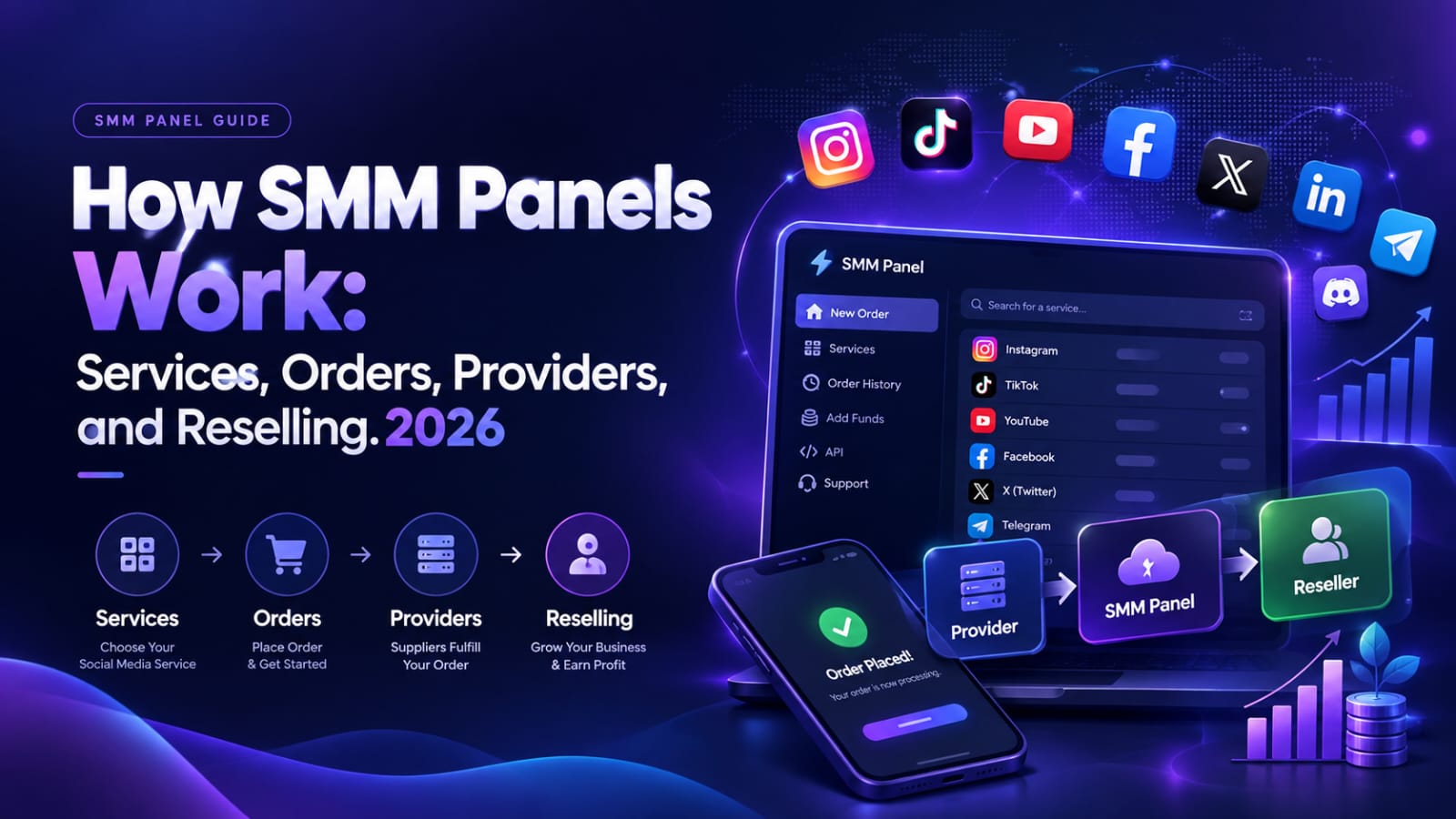

Most people encounter SMM panels from one side only: a checkout page where you pick a quantity and pay. What happens after you click "order" is a lot more interesting — and understanding it makes you a sharper buyer, whether you're growing one account or building a reselling business on top of a panel's infrastructure.
What an SMM Panel Actually Is
At its core, an SMM panel is a storefront connected to a delivery network. You choose a service, enter a link or username, select a quantity, and pay — the panel handles everything after that automatically. If you want the fuller picture of how panels fit into the broader social media marketing space, our what is an SMM panel guide covers that from the ground up. This post goes one layer deeper: what's actually happening between "order placed" and "order delivered," and how that same system powers reselling.
How Services Are Structured
Panels typically organize services by platform first, then by metric type. The categories tend to repeat across almost every panel because they map to what platforms actually measure:
- Growth metrics — followers, subscribers, and page likes, which build the visible size of an account or channel.
- Engagement metrics — likes, comments, and reactions on individual posts.
- Reach metrics — views on videos, Reels, Stories, and live streams.
- Community metrics — members for Telegram or Discord groups, or joiners for live audio spaces.
- Niche add-ons — services like website traffic, Spotify streams, or app installs that fall outside core social platforms but run through the same panel infrastructure.
Each service usually lists its own speed, minimum and maximum order size, and whether it includes a refill guarantee — details worth checking before quantity, not after.
What Happens When You Place an Order
The steps look simple from the front end, but each one triggers something specific on the back end:
Once payment clears, the panel doesn't fulfill the order itself in most cases — it passes the order details (link, quantity, service ID) to a provider through an API call, largely the same way a retailer's website passes your order to a warehouse. The provider's system queues the job and begins delivery, usually in gradual batches rather than a single instant drop. The panel then polls the provider for status updates, which is what populates the "in progress," "completed," or "partial" status you see on your order.
The Provider Layer: Where Panels Actually Source From
This is the part most buyers never see, and it explains almost every pricing and quality difference between panels:
- Top-tier providers — own or directly manage the actual delivery infrastructure and account networks. Prices here reflect real operating cost.
- Mid-tier panels — buy access to top-tier providers in bulk, then resell that access to smaller panels with a markup, often bundling several providers together for redundancy.
- Storefront resellers — run a branded panel on top of a mid-tier or top-tier connection, setting their own prices and support, without owning any delivery infrastructure themselves.
A single order can pass through two or three of these layers before it ever reaches the platform you're growing on. That's normal and not inherently a red flag — but it's also why the same underlying delivery can show up under wildly different prices depending on which layer you're buying from.
How Reselling Fits Into This System
Because panels expose their order system through an API, anyone can build a storefront on top of an existing panel rather than building delivery infrastructure from scratch. In practice, this is how a large share of SMM businesses actually start: a reseller connects to a panel's API, marks up the pricing, and handles customer-facing sales and support while the underlying panel handles fulfillment.
This is a legitimate and common business model — it's closer to dropshipping than anything resembling a scheme, since the reseller is adding real value through support, curation, and often better pricing for smaller order volumes. We've covered the mechanics of building this kind of business — sourcing a reliable panel, setting margins, and managing customer support — in a dedicated guide, which we'll cross-link here once that page's live slug is confirmed.
APIs: The Connective Tissue Behind Every Panel
Every layer described above — provider to mid-tier panel, mid-tier panel to reseller storefront — is connected through the same basic mechanism: an API that accepts an order (service ID, link, quantity) and returns a status. You don't need to touch this layer at all to place a normal order through a panel's website. But if you're planning to resell, automate bulk ordering, or connect a panel into your own tools, that's exactly what FollowSMM's API is built for. We also have a deeper technical walkthrough of API integration that we'll link here directly once its slug is finalized.
Is Any of This Legal?
Buying engagement services isn't illegal in the way piracy or fraud are — it's a gray area that platforms discourage in their terms of service but that isn't criminalized in most jurisdictions. The honest framing is: it's a terms-of-service risk, not a legal one, and the actual risk level depends heavily on the type of service and how it's delivered. We go into this in more depth in our dedicated legality guide, which we'll cross-link once that slug is verified live.
What Separates a Reliable Panel From a Risky One
Whether you're ordering for one account or evaluating a panel to resell through, the same checklist applies:
- Transparent provider chain — a reliable panel doesn't hide whether it's a direct provider or a reseller of one.
- Working refill policy — stated in writing, not just implied in marketing copy.
- Gradual, traffic-friendly delivery — instant bulk drops are the clearest sign of low-quality sourcing.
- No password requests — legitimate panels only ever need a public link or username.
- Responsive support — a panel you can actually reach matters more once something goes wrong with an order, not before.
- API documentation available — even if you never use it, a panel that publishes clear API docs is generally more operationally mature.
The FollowSMM Advantage
We built FollowSMM around the parts of this system that are easiest for buyers and resellers to get wrong elsewhere:
- Traffic-friendly delivery — orders are sourced through real, organic-looking traffic rather than bot networks, so results don't distort your analytics or trigger platform review.
- Transparent provider sourcing — no hidden layers you have to guess about; delivery speed and refill terms are listed on every service.
- Documented, reseller-ready API — built for anyone connecting FollowSMM into their own storefront or automation, not just one-off orders.
- Refill protection on eligible services — drops within the guarantee window are topped up automatically.
- Zero password requests, ever — only a public username or link is ever required.
- Real support — live chat, WhatsApp, and Telegram, actively monitored rather than a contact form black hole.
Whether you're placing a single order or building a reselling business on top of our API, the same infrastructure and pricing apply — see the full list of what's available on our services page, or check common questions on our FAQ page first.
Explore More
If any part of this system is relevant to what you're building, these are good next stops:
- SMM services — browse the full catalog, with delivery speed and refill terms listed on every listing, on our services page.
- API guide — the live API page covers endpoints and access; a deeper step-by-step integration guide is in progress and will be linked here once its slug is confirmed.
- Reseller guide — a dedicated guide to building a reselling business on top of a panel is in progress and will be linked here once its slug is confirmed.
- Platform-specific guides — regional breakdowns for Dubai, the USA, and worldwide coverage, plus platform-specific pricing in our Instagram followers guide.
- Related educational content — start with our foundational What Is an SMM Panel guide if you're new to any of this.
Frequently Asked Questions
What is an SMM panel?
An SMM panel is an online dashboard where you select social media services — like followers, views, or likes — enter a link or username, and place an order. The panel then routes that order to a provider network for delivery.
How do SMM panels deliver orders so quickly?
Panels connect to provider APIs behind the scenes. The moment an order is placed, it's automatically forwarded to a provider's delivery system, which is why many orders start processing within minutes rather than requiring manual work.
Can I become a reseller using an SMM panel?
Yes. Reselling means building your own storefront on top of a panel's API, setting your own prices, and letting the underlying panel handle order fulfillment. Many SMM businesses start this way rather than building delivery infrastructure from scratch.
Do I need to know how to code to use a panel's API?
Basic API integration requires some technical comfort, but most panels provide documentation and simple request formats. Many resellers use ready-made scripts or hire a developer for a one-time setup rather than writing everything from scratch.
Is using an SMM panel safe for my account?
It depends heavily on the provider. Panels that use gradual, traffic-friendly delivery and never request your password carry far less risk than those offering instant bulk delivery from low-quality sources.
Order Directly, or Build on Our API
Transparent sourcing, traffic-friendly delivery, and reseller-ready documentation — see how FollowSMM's infrastructure works for buyers and resellers alike.